Showing posts with label fabrique de jardin. Show all posts

Sunday, February 22, 2026

ON A WINTER STROLL IN PARIS


Winter in the Parc Monceau, one of the most elegant parks in Paris to go for a stroll.

This colonnade is one of the park's many fabriques de jardin, an ornamental
construction designed to please the eyes of passersby and to stimulate their imaginations. 
The basin the columns wrap around represents a naumachia, which during antique Roman times was
an artificial lake where naval battles were reenacted for spectators.
©2026 P. B. Lecron

Sunday, August 3, 2014

NOT FOR THE FAINT OF HEART

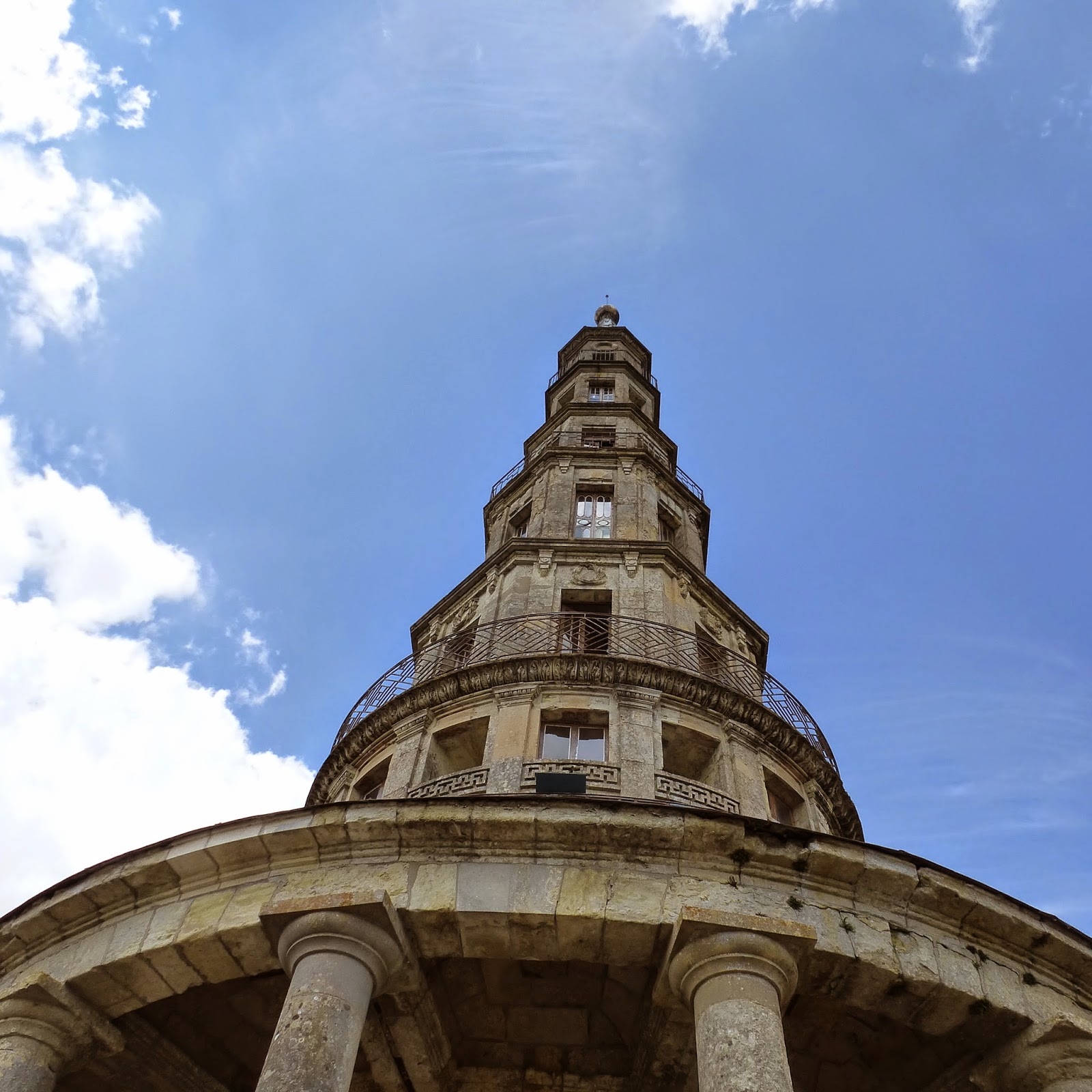
We didn't count the steep steps up the narrow, winding staircases of the seven levels of the fanciful Pagode de Chanteloup, but they do add up to an exotic 44-meter ascension. The climb is recommended neither for the faint of heart nor for more than six people at a time. 

Erected in 1775 by the affluent Duc de Choiseul, this fabrique de jardin or architectural folie, is bordered by an ornamental lake in the form of a demi-moon. When the duke, once an all-important minister to Louis XV, lost favor with the king he was exiled from the royal court to Chanteloup. On the grounds of his magnificent château there, he built the pagoda and dedicated it to friends and supporters who surrounded him after his fall from power. 

The pagoda is all that rests of the estate. The château was entirely destroyed in the 19th century by unscrupulous real estate speculators, loosely known as the bande noire, who after the French Revolution dismantled historic domains in order to resell the buildings' materials and decorative elements. A visit to the pagoda, not far from the royal city of Amboise, is a pleasant interlude when exploring châteaux in the Loire Valley. 


Vocabulary
une pièce d'eau:  an ornamental pond or lake

©2014 P.B. Lecron

Saturday, July 6, 2013

CULTURAL FABRIC

The tie that binds...
From the heart of the Bois de Boulogne overlooking a profusion of roses in the Parc Bagatelle: the Kiosque de l'Impératrice. It's one more example of a fabrique de jardin, an appeasing decorative garden structure, which like roses, has universal appeal.

Vocabulary
apaiser:  to appease, to calm

©2013 P.B. Lecron

Friday, September 21, 2012

AFTERTHOUGHT

In French you'll hear the idiomatic "renvoyer l'ascenseur" often enough, meaning to send back the elevator, i.e., to return the favor, or in some cases to respond to a misdeed by a misdeed; but the imaginative "l'esprit de l'escalier" is a bit more arcane. Literally it means "staircase wit" and is used to describe the feeling you get when you think of a riposte only after the conversation has ended. The idiom comes from a passage in Paradoxe sur le Comédien written in 1778 by Denis Diderot, the French philosopher and writer of 18th-century encyclopedia fame, where he laments not thinking of a reply to an argument against him until he was at the bottom of the stairs. 

We were left speechless, too, at the bottom of the stairs to this pretty wrought-iron gloriette, which sits high atop an artificial cave, La Grotte des Quatre Vents, in the Parc de Bagatelle in the Bois de Boulogne. Like a number of other fabriques de jardin that still exist in the park, the grotto dates to the 18th century. The gloriette was a later 19th-century afterthought.

Vocabulary
une gloriette:  usually a wrought-iron pavillon in the form of a bird cage; it can also designate a small decorative neoclassic garden pavillon
une grotte:  a cave
un escalier:  a staircase
l'esprit:  mind; wit; spirit
une repartie:  a repartee,  a quick, witty reply


Friday, July 13, 2012

WHEN ICE WAS A LUXURY

In this 18th-century glacière, ice, a culinary luxury, was once stocked during the winter months for use later in the year in a semi-subterranean, masoned excavation. This exceptional example of a fabrique de jardin is one among the remaining architectural folies at the Désert de Retz, a landscaped garden created in 1774 by the aristocrat François Racine de Monville. The site, one of the most famous of its time, was a product of the Siècle des Lumières or Age of Enlightenment. At that time the word "désert" was often the term used for a place where one could withdraw from the everyday world to think and to reflect. Illustrious guests to this garden retreat included Madame du Barry, King Gustave III of Sweden, Benjamin Franklin and Thomas Jefferson. Marie-Antoinette visited the Désert de Retz several times, taking inspiration for the construction of her own follies--a hamlet and dairy: the Hameau de la Reine in the park of the Château de Versailles and the Laiterie de la Reine in the park of the Château de Rambouillet. 

Vocabulary
la folie:  folly, madness
une fabrique de jardin:  an ornamental construction designed to decorate a landscaped garden, and which generally has an exotic or extravagant form inspired by architectural elements of antiquity, history or nature
une glacière:  an icehouse